
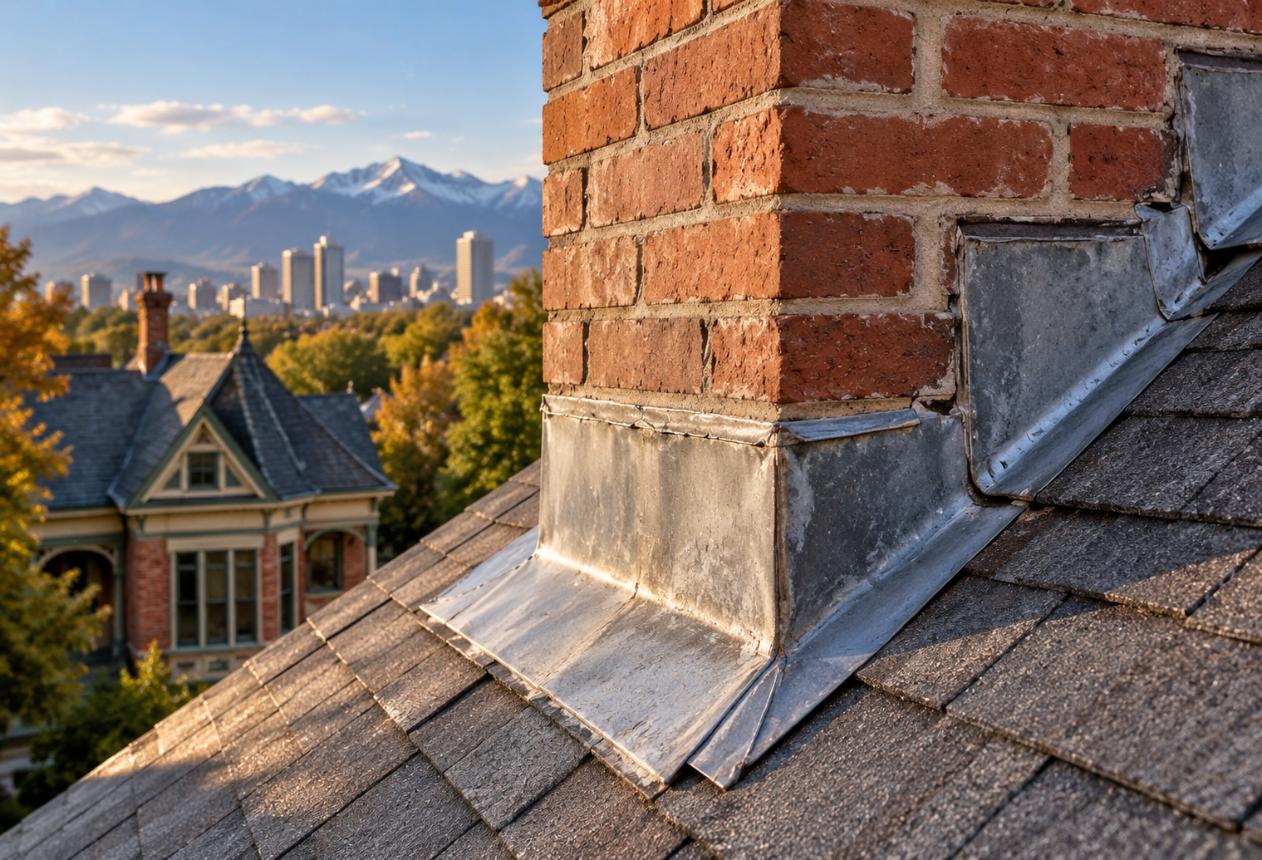
A roof leak in an older Denver home does not always start with damaged shingles. Around historic masonry chimneys, water can slip through failed flashing, travel along framing or masonry, and appear inside far from the actual entry point.
Quick answer: Chimney flashing failure is a common hidden source of roof leaks in historic homes because flashing forms the watertight transition between the roof and chimney. Aging metal, deteriorated sealants, masonry movement, improper previous repairs, snow and freeze-thaw conditions can compromise that transition. Finding the source early can help limit damage to roof decking, ceilings, insulation, plaster, and masonry.
What local homeowners should know
-
Water stains near a chimney do not automatically mean the chimney masonry itself is leaking.
-
Older homes in neighborhoods such as Capitol Hill, Congress Park, Washington Park, and Highland may have roofing and chimney details that have been repaired or altered multiple times.
-
Front Range snow, rapid temperature changes, hail, and freeze-thaw cycles can expose weaknesses around roof penetrations.
-
Caulk alone is generally not a substitute for properly installed chimney flashing.
-
A professional roof inspection can help distinguish flashing problems from chimney cap, masonry, roof covering, or condensation issues.
Why Does Chimney Flashing Failure Matter in Denver?
Chimney flashing failure matters in Denver because local roofs regularly experience snow, hail, strong sun, temperature swings, and freeze-thaw conditions that can stress the joint where roofing meets masonry. On an older house, that vulnerable transition may also contain decades of previous repairs, making the true source of a leak harder to identify.
Historic and older housing throughout central Denver adds another consideration. Rooflines, masonry chimneys, additions, reroofing projects, and previous patchwork can create complicated drainage conditions.
Quality Roofing Co. can help property owners determine whether water intrusion is coming from chimney flashing or another part of the roofing system. From this point forward, we focus on identifying the actual source before recommending an appropriate roofing solution.
What Do Local Conditions Tell Us About Chimney Flashing?
Local conditions suggest chimney flashing deserves special attention because exposed roof-to-masonry joints must handle repeated weather changes while directing water around a rigid penetration. Rather than assuming every chimney leak has one cause, the flashing, surrounding roof covering, masonry, cap, and nearby drainage paths should be evaluated together.
This is particularly useful on older properties near Cheesman Park, City Park, and other established parts of the city where chimneys may have survived several generations of roofing work.
A field inspection can reveal whether flashing has pulled away, corroded, been covered by roofing materials, or received repeated surface patches. Those observations are often more useful for an individual property than broad statistics because every historic roof has its own repair history.
How Can Failed Chimney Flashing Affect a Historic Home?
Failed chimney flashing can allow water into roof decking, framing, insulation, ceilings, walls, and finishes while leaving relatively subtle exterior evidence. Historic homes can be especially vulnerable because water may travel behind old plaster, through masonry joints, or along framing before a homeowner notices visible staining.
Repeated moisture can turn a small exterior defect into a larger repair issue. Wet insulation may lose effectiveness, wood components can deteriorate, and interior finishes may require repair.
The objective is not simply to stop the visible drip. It is to locate and correct the path that allowed water into the roof assembly.
What Are the Warning Signs of Chimney Flashing Failure?
Warning signs of chimney flashing failure include staining near the chimney, visible gaps in metal flashing, recurring leaks after storms, and repeated patches that do not permanently solve the problem. Because water can travel before becoming visible indoors, symptoms should be evaluated rather than used as proof of a specific failure.
Watch for:
-
Brown or yellow ceiling stains near the chimney.
-
Damp plaster, drywall, or trim following rain or melting snow.
-
Loose, bent, rusted, or separated flashing.
-
Cracked or deteriorating sealant around previous repairs.
-
Shingles or roofing materials lifting beside the chimney.
-
Recurring leaks despite previous caulking.
-
Moisture or staining in an attic near chimney framing.
-
Interior symptoms that worsen during snowmelt or wind-driven rain.
When Should You Call a Roofing Professional?
Call a roofing professional when leakage recurs, flashing is visibly loose or damaged, interior materials are becoming wet, or safely identifying the source would require getting onto the roof. Homeowners can monitor interior stains and inspect accessible attic areas, but steep roofs and deteriorated historic materials are better evaluated professionally.
After a Denver hailstorm or a winter weather cycle, checking from the ground for obvious changes can be useful. Avoid climbing onto a wet, icy, steep, or damaged roof.
Professional evaluation becomes particularly valuable when several possible water-entry points surround the chimney.
What Commonly Causes Chimney Flashing Problems in Denver?
Common chimney flashing problems include aging materials, improper installation, movement between masonry and roofing components, failed surface sealants, and damage associated with severe weather or previous roof work. In Denver, temperature changes and snowmelt can repeatedly test any weakness already present around the chimney.
Common causes include:
-
Aging flashing: Metal components can corrode, loosen, bend, or simply reach the end of their useful condition.
-
Improper previous repairs: Roofing cement or sealant may temporarily cover a symptom without correcting defective flashing underneath.
-
Freeze-thaw movement: Moisture entering small openings can contribute to deterioration as temperatures move above and below freezing.
-
Hail and storm damage: Severe weather can affect roofing materials and vulnerable details surrounding penetrations.
-
Masonry deterioration: Cracked mortar or damaged brick can introduce another possible water path.
-
Reroofing complications: Previous roofing work may leave poorly integrated flashing around an older chimney.
How Can Homeowners Help Prevent Chimney Leaks?
Homeowners can help prevent chimney leaks by monitoring the roof-to-chimney joint, addressing visible deterioration promptly, and including flashing in periodic roof inspections. Local seasonal timing matters, particularly before winter weather and after significant hail or wind events.
From the ground, look for displaced roofing materials or obviously separated metal. Inside, check accessible attic areas for staining when conditions are safe.
DIY work should stop before walking on steep roofing, dismantling masonry, or applying sealants without knowing the leak source. Covering flashing with more caulk can make later diagnosis harder without resolving the underlying defect.
What Results Should You Expect From Chimney Flashing Repair?
A proper chimney flashing repair should restore a reliable transition that directs water away from the roof-to-chimney joint while integrating correctly with the surrounding roofing system. The exact repair depends on whether the problem involves a localized defect, broader flashing failure, surrounding roofing materials, or masonry-related water entry.
Some roofs may need targeted flashing work. Others may require removal of nearby roofing materials so the flashing can be correctly rebuilt and integrated.
A good inspection should clarify what appears damaged, what needs to be disturbed for repair, and whether other chimney components require attention from an appropriate specialist.
What Mistakes Make Chimney Leaks Worse?
The biggest chimney-leak mistakes are repeatedly patching symptoms, assuming the closest visible stain marks the entry point, and delaying investigation until interior damage expands. Older Denver homes can have complex water paths, so diagnosis matters as much as the repair itself.
Mistake: Applying another layer of caulk over deteriorated flashing.
Consequence: The underlying defect may continue admitting moisture.
Better approach: Determine whether the flashing itself needs repair or replacement.
Mistake: Assuming damaged mortar is responsible for every chimney-area leak.
Consequence: Roofing defects may remain untreated.
Better approach: Evaluate both masonry and roofing-related water paths.
Mistake: Waiting for the next major storm to confirm a suspected leak.
Consequence: Additional moisture may enter the assembly.
Better approach: Investigate recurring stains before another Front Range weather event tests the roof.
What Is a Common Local Chimney-Leak Scenario?
A common local scenario is an older home that develops an interior stain beside the chimney after rain or melting snow, even though the surrounding roof appears reasonably intact from the ground. This is an illustrative Denver-area scenario, not a Quality Roofing Co. case study.
The homeowner may initially suspect shingles or masonry and apply a surface sealant. The stain later returns because the actual water path involves the flashing beneath or alongside the roof covering.
A thorough inspection then focuses on how the roofing, flashing, chimney, and drainage pattern interact instead of treating the visible stain as the source.
What Roofing Services Can Address Chimney Flashing Problems?
Roof inspections, leak diagnosis, flashing repair, and related roof repair can address chimney-area water intrusion when the roofing system is responsible. The right service depends on the condition of the existing materials and whether the defect is isolated or part of a broader roofing problem.
We can evaluate the roof area surrounding a chimney and explain the roofing work that appears appropriate based on its condition.
Should You Repair the Flashing or Replace More of the Roof?
Repairing the flashing makes sense when the problem is localized and the surrounding roofing remains serviceable, while broader replacement may be appropriate when deterioration extends beyond the chimney area. The decision should be based on actual roof condition rather than the presence of a leak alone.
A localized repair generally limits work to the affected roof and flashing components. More extensive work may make sense when roofing materials are significantly deteriorated, multiple leak sources exist, or proper flashing integration requires addressing a larger section.
Historic properties deserve particular care because existing construction details may differ from newer homes.
What Areas Do We Serve?
We serve homeowners in Denver and surrounding communities where chimney flashing and roof leaks can affect both older and newer properties. Local roofing needs vary across neighborhoods and nearby Front Range communities, so inspection findings should guide the repair rather than a one-size-fits-all recommendation.
What Can Happen If You Ignore a Chimney Flashing Leak?
Ignoring a chimney flashing leak can allow repeated moisture intrusion to affect roofing materials, insulation, framing, ceilings, walls, and interior finishes. In a historic Denver property, waiting can also make it more difficult to determine the original water path once several materials have become damp or deteriorated.
A small stain does not tell you how much of the assembly has been exposed. Addressing the source early can help reduce the amount of secondary repair that may become necessary.
FAQ About Chimney Flashing and Historic Denver Homes
How do I know if my Denver chimney flashing is leaking?
Recurring moisture near the chimney is a reason to inspect the flashing, but it does not prove the flashing is responsible. Check for stains, damp attic materials, loose metal, deteriorated sealant, and changes after storms or snowmelt. A roof inspection can separate flashing failure from masonry, cap, or other roofing problems.
Why are older Denver homes vulnerable to chimney-area leaks?
Older Denver homes may be more vulnerable because their chimneys and roofs can contain aging materials and layers of previous repairs or reroofing work. Historic construction details can also make water paths less obvious. Local snow, hail, sun, and temperature changes continually test already weakened roof-to-masonry connections.
Can I just caulk leaking chimney flashing?
Caulk may seal certain minor joints, but it is not a universal replacement for correctly installed flashing. If flashing is loose, improperly integrated, corroded, or otherwise failing, applying more sealant may only cover the symptom temporarily. The underlying roof-to-chimney transition should be evaluated before choosing a repair.
Can melting snow cause chimney leaks in Denver?
Melting snow can reveal existing weaknesses around chimney flashing because water may enter gaps as accumulated snow melts and drains across the roof. Freeze-thaw conditions can also contribute to deterioration in vulnerable materials. A leak appearing during snowmelt should still be diagnosed because several roof or masonry components could be involved.
Does hail damage chimney flashing?
Hail can affect roofing materials and roof details around a chimney, although the presence of hail does not automatically mean flashing has failed. After a significant Denver-area storm, homeowners can watch for new interior moisture or visible exterior changes and arrange an inspection when damage is suspected.
Is a chimney leak always a roofing problem?
No, a chimney leak is not always a roofing problem. Water may enter through flashing, surrounding roofing, deteriorated masonry, mortar joints, chimney caps, or other components. Because several sources can produce similar interior symptoms, identifying the actual entry path is essential before beginning repairs.
Should historic-home chimney flashing be inspected before winter?
Inspecting questionable chimney flashing before winter can be useful because snow, ice, and freeze-thaw cycles may expose existing weaknesses. Denver homeowners who have noticed previous stains, loose flashing, aging repairs, or unexplained attic moisture have an especially good reason to investigate before colder weather arrives.
Can flashing be repaired without replacing my entire roof?
Yes, chimney flashing can sometimes be repaired without replacing the entire roof when the defect is localized and surrounding roofing materials remain suitable for repair. The existing roof condition and flashing design determine what is practical. An inspection should establish whether targeted work or a broader roofing solution makes more sense.
Chimney leaks in historic homes can be deceptive, especially when the visible stain is several feet from the true entry point. Understanding how flashing, roofing, masonry, and Front Range weather interact gives local homeowners a better basis for deciding what to repair.
Protect Your Denver Home From Recurring Chimney Leaks
Quality Roofing Co. can help identify roofing-related water entry around your chimney and explain the repair options appropriate for the conditions we find.